The first thing my sister did when she saw me in my military dress blues on my wedding day was laugh.
Not smile awkwardly. Not blink in surprise. Not pause, the way a person might when the image in front of them does not match what they expected. She laughed from somewhere sharp and practiced, a small polished sound that made the preparation room at Marine Corps Base Quantico feel suddenly smaller than it had been a second before.
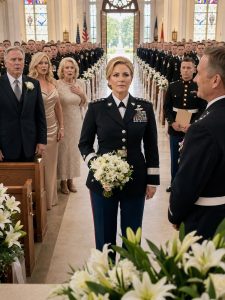
For one strange moment, I noticed everything except her face.
I noticed the smell of old wood polish beneath the heavy sweetness of fresh lilies. I noticed the warm bulbs around the mirror humming softly above the vanity. I noticed the ivory designer gown still hanging on the chair across from me in its clear plastic cover, untouched and expensive and perfect in the way things are perfect when they are meant for someone else. I noticed the little fold in the carpet near the door, the chapel schedule on the table, the pair of white gloves laid beside my phone, and the way my own reflection looked both familiar and impossible.
The midnight-blue jacket sat sharp across my shoulders. My medals rested where they belonged. Four silver stars caught the light and threw it back in cold little flashes.
General Rebecca Hayes.
I had carried that name and title through briefing rooms, command centers, hearings, memorial services, and long nights when decisions had to be made with incomplete information and no room for self-pity. I had worn stars in places where people looked first at the rank, then at the woman, then back at the rank as if checking whether their eyes had betrayed them. I had learned how to let a room underestimate me for exactly as long as it took to make that mistake useful.
But on my wedding day, in a small preparation room with my family standing in the doorway, I felt sixteen again.
Not because I doubted the uniform.
Because they did.
Vanessa stepped in first, as she always did, taking up more space than her body required. She wore a champagne-colored dress fitted so precisely it seemed sewn around her confidence. Her blonde hair fell over one shoulder in careful waves, and her makeup had the soft glow of money and time. Behind her came my mother, Diana Hayes, touching her pearl earrings in anxious little taps. My father, Robert, came last, already wearing the expression I knew too well: disappointment dressed up as patience.
Vanessa looked me over slowly.
Not the way a sister looks at a bride.
The way a judge examines evidence.
Her gaze moved from my polished shoes to my pressed trousers, from the jacket to the ribbons, from the collar to the stars on my shoulders. Then she laughed again, and this time she shook her head as if she had just witnessed something embarrassing at a dinner party.
“Oh my God,” she said. “You actually went through with it.”
“Good morning to you too,” I said.
My voice came out calm. That surprised me. My hands had trembled while I fastened the last button, but now they hung still at my sides.
Vanessa crossed her arms. “Rebecca, seriously. You couldn’t act normal for one day?”
My mother gave me a pleading look, the kind she had used my whole life when she wanted me to make her discomfort disappear. “Honey, there’s still time to change.”
Her eyes flicked toward the gown in the chair.
I looked at it too.
The gown had arrived two weeks earlier at Daniel’s townhouse in Alexandria, boxed in silver paper, no card attached. No phone call. No text asking what I wanted. No “Are you happy?” No “How can I help?” Just a dress selected by my mother, shipped like a final correction.
That was how my family loved when they remembered to love at all.
They sent instructions and called them care.
“The gown is beautiful,” my mother said softly.
“So is this,” I said.
For a second, she had no answer.
Vanessa did.
“No,” she said, her voice flattening. “This is sad.”
The word landed harder than it should have, because it had been wrapped in other words my entire life.
Too hard.
Too cold.
Too ambitious.
Too masculine.
Too much.
Not enough.
“You look like you’re reporting for duty instead of getting married,” Vanessa said. “Daniel deserves a wife, Rebecca. Not some military mascot.”
The room went so still that I could hear someone laugh faintly down the hall and then stop. The lilies seemed suddenly too fragrant. My mother looked at the floor. My father sighed as if the morning had become a burden he was too tired to carry.
“You’ve always made everything harder than necessary,” he muttered.
That sentence reached backward through my life and opened doors I had nailed shut.
I was twelve again, sitting at the kitchen table in our house in Fairfax while Vanessa cried because she had lost a dance competition, and my father told me to stop showing her my science fair ribbon because she was having a difficult day.
I was sixteen, hiding a Marine Corps brochure beneath my chemistry notebook because I already knew my family would mock the idea before asking why it mattered to me.
I was twenty-two, home on leave, listening to my mother say my haircut made me look “severe,” while Vanessa asked whether I had to wear “those boxy little outfits” everywhere.
I was thirty-five, newly promoted, sitting alone in a hotel room after a formal event, watching the family group chat go silent the moment my name made the news.
A person can survive war and still be wounded by the kitchen table.
I let my breath move through me once, then again.
There are battles you win by not giving your opponent the scene they came to watch.
“I didn’t wear this uniform to impress anyone,” I said quietly. “I earned it.”
Vanessa’s smile curled at one corner. “Sure you did.”
My mother closed her eyes for half a second. My father looked toward the door, as if hoping someone else would enter and rescue him from having to choose between the daughter he understood and the daughter he had never bothered to know.
Before I could say anything else, a young Marine appeared in the doorway. He was tall, clean-cut, perhaps twenty-four, with the composed posture of someone who had been given a simple duty and intended to perform it perfectly.
“Ma’am,” he said. “The ceremony is ready.”
It was such a simple sentence.
Still, it changed the air.
Because he knew who I was.
Not the difficult daughter. Not the inconvenient sister. Not the woman who had failed some invisible family test of femininity. He knew the rank, the years, the command, the name printed on the program.
I nodded once. “Thank you.”
Then I turned and walked past my family.
Vanessa gave a small, sharp laugh behind me, but it did not catch. My mother’s perfume followed me into the hall for two steps, then faded into the colder smell of stone and polished brass.
The chapel doors waited at the end of the corridor.
For half a second, I could hear my heartbeat. I could also hear Daniel’s voice from two weeks earlier, when I had stood in our kitchen holding the garment bag my mother had sent, trying not to feel ridiculous for being hurt by a dress.
“If the uniform helped shape your life,” he had said, “then wear it proudly.”
I had waited for the pause, the careful smile, the gentle suggestion that maybe my mother had a point. People had been asking me to soften the edges of myself for as long as I could remember.
Daniel did not pause.
“I’m not marrying a costume, Rebecca,” he said. “I’m marrying you.”
That sentence carried me now.
The young Marine reached for the chapel handle. The door opened, and light spilled across the stone aisle.
The chapel was full.
Not politely full. Not wedding full. Full in the way a room becomes full when history sits down inside it.
Five hundred Marines filled the pews in dress uniforms, shoulders squared, faces forward, discipline so complete that the air itself seemed to stand at attention. Stained-glass light broke across medals, ribbons, white gloves, polished shoes, and solemn faces. There were officers who had served above me, beside me, and under me. There were combat veterans who had known me in places where decisions could not be polished afterward. There were people who had seen me lead, fail, learn, grieve, stand, and keep standing.
At the altar waited Daniel Mercer.
He was not a loud man. Maybe that was why I trusted him. He did not perform love for an audience. He showed up with coffee before hearings, kept spare batteries in the kitchen drawer because I forgot them, and once drove three hours through sleet just to sit beside me in a hospital waiting room after one of my former Marines had been injured in a training accident.
His gray suit was simple. His dark hair was neatly combed. His hands were clasped in front of him, but his eyes were bright.
He did not look embarrassed.
He did not look worried that I had failed to become softer for the room.
He looked proud.
The kind of proud that does not need to announce itself because it has already taken root.
I stepped forward.
Every Marine in the chapel stood.
All at once.
The sound hit like weather. Five hundred bodies rising in perfect unison, pews shifting, heels finding stone, fabric moving, breath catching. No one hesitated. No one glanced around to see what anyone else was doing. They simply rose.
Behind me, my sister stopped moving.
Then the command came.
“GENERAL ON DECK!”
The words struck the stone walls and came back larger. They filled the chapel, rolled beneath the high ceiling, and pressed every private insult my family had brought with them into something small and breakable.
Vanessa’s face lost color.
My mother froze with one hand at her pearls. My father turned his head from row to row, eyes widening as decorated leaders saluted me with the kind of respect he had spent my whole life refusing to imagine.
For years, my family had treated my career like an eccentric habit. A phase. A defense mechanism. A problem I might outgrow if someone bought me the right dress. But there is a moment when truth becomes too public to deny.
Not loud truth.
Not theatrical truth.
Just five hundred witnesses standing in perfect discipline because they already knew what my family had chosen not to see.
I walked down the aisle.
My shoes sounded steady against stone. Each step carried me past men and women who had trusted me with decisions, missions, lives, consequences, grief, and honor. Each step carried me farther from the preparation room, the garment bag, the text messages, and the old family habit of making me smaller so they could feel normal.
Vanessa did not laugh again.
I saw her from the corner of my eye, rigid and pale, one hand clutching her purse so tightly her knuckles showed.
My mother looked as if she wanted to speak, but there was no place for the kind of apology people make only after an audience arrives.
My father’s mouth tightened. For the first time in my memory, he looked uncertain.
That did something strange to me.
It did not feel like revenge.
It felt quieter than that.
It felt like finally setting down a heavy bag I had been told was part of my body.
Daniel’s face steadied me. He smiled through tears, and I almost smiled back.
Almost.
Because then I saw the man standing near the altar beside him.
He wore a dark suit, not a uniform. The cut of it was formal, controlled, official. He was not part of Daniel’s family. He was not one of my old commanders. He was someone everyone in that room seemed to recognize at nearly the same time, because a ripple passed through the front rows without a single person speaking.
The Secretary of Defense stood near the altar.
In his hands was a sealed folder.
For one suspended second, I did not understand why he was there.
This was supposed to be a wedding. A military wedding, yes, but still a wedding. A day with vows, flowers, a chaplain, a reception, a cake someone had probably spent too much money on, and Daniel waiting at the end of the aisle with the soft patience that had saved me more than once.
The Secretary stepped forward. His smile was careful, respectful, almost solemn.
“General Hayes,” he said.
The chapel remained standing.
My name was typed across the front of the folder.
My family saw it too.
Vanessa followed the movement of the folder as if it were a blade turned toward her. My mother tightened her fingers at her throat. My father looked from the Secretary to me, and in his expression I saw a question he had never asked before.
Who are you, really?
I wanted to tell him I had been standing in front of him the whole time.
The Secretary extended the folder toward me.
For the first time all morning, my hands truly trembled.
Not because Vanessa had hurt me. Not because my father had disappointed me. Because whatever was inside that folder had brought the Secretary of Defense to my wedding and kept five hundred Marines standing in silence.
I reached for it.
The seal caught the stained-glass light.
“Rebecca,” Daniel said softly, and only I could hear the wonder in it.
The Secretary’s eyes held mine. “On behalf of the President of the United States, the Department of Defense, and the men and women who served under your command, I’m honored to present this to you today.”
The chapel remained breathless.
“This morning,” he continued, “the President approved the public announcement of your appointment as the next Commandant of the Marine Corps.”
For a heartbeat, the sentence did not enter me.
It hovered there in the light above the aisle, impossible and official and larger than the room.
Then the chapel erupted.
Not into chaos. Marines do not erupt that way. But into a thunder of applause so controlled and so powerful that it seemed to shake the glass in the windows. Hands struck together. Boots shifted. A few voices rose in “Oorah!” before discipline pulled them back into themselves. The sound washed over me, and for the first time in years, I did not know what to do with my face.
Commandant.
The first woman to hold the office.
The first Marine like me to sit in that chair.
I stared at the folder. I had known I was under consideration. Of course I had known. At that level, nothing is entirely secret. There had been interviews, background checks, quiet calls, policy meetings that sounded routine only to people who did not know how power moved. But final approval had not come. Public announcement had not been scheduled. I had deliberately pushed the possibility to the edges of my mind because I refused to let ambition stand beside me at the altar.
This was my wedding day.
This was Daniel’s day too.
Yet Daniel was clapping with both hands, smiling like something inside him had burst open into light.
The Secretary leaned closer, his voice lowering just enough to be personal. “Your office requested that this announcement be made Monday. The White House agreed. Your fiancé asked whether the signed notice could be delivered today instead, privately, before the public release. He said your family might benefit from hearing the truth in a room full of people who already knew it.”
I turned to Daniel.
His smile faltered slightly, as if he had been caught doing something both tender and bold.
“I didn’t know if they’d agree,” he said under the applause. “I only asked them not to let your family’s voices be the loudest ones you heard today.”
Something inside me folded, then opened.
For most of my life, love had felt like negotiation. If I achieved, I had to apologize for making others uncomfortable. If I hurt, I had to explain why the wound was reasonable. If I wanted, I had to prove the wanting did not inconvenience anyone.
Daniel had not asked me to explain why I needed protection from my own family.
He had simply stood where the hurt was coming from and put something stronger in front of me.
The applause slowly softened. The Secretary stepped back, and the chaplain, a silver-haired Navy captain with kind eyes, waited with the patience of someone who understood ceremony better than most.
I realized I was still holding the folder.
The announcement inside felt heavier than paper.
My mother had always wanted me to be delicate on my wedding day. She had imagined lace and satin and soft curls, all the things she believed would make me acceptable in a way my life had not.
Instead, I stood in dress blues with the future of the Marine Corps sealed in my hands.
The chaplain cleared his throat gently. “General Hayes, would you like a moment?”
I looked at Daniel. Then I looked at my family, standing near the back of the chapel with the expressions of people who had arrived at a wedding and found themselves at a reckoning.
Vanessa’s lips were pressed together so tightly they had gone pale. My mother’s eyes shone with tears, though I could not yet tell whether they were pride, shame, or the discomfort of being watched. My father looked smaller somehow, not physically, but in the way certainty can shrink when truth removes its scaffolding.
I thought about taking a moment.
I thought about letting the room breathe.
I thought about all the years I had given my family time to become kinder, wiser, braver.
Then I placed the sealed folder gently on the small table beside the altar and turned toward Daniel.
“No,” I said. “I’m ready.”
The chapel quieted.
Daniel took my hand.
His palm was warm. Mine was cold.
The chaplain began the ceremony, and for a little while, the world narrowed to Daniel’s eyes, the sound of vows, and the astonishing tenderness of being chosen without conditions.
“We are gathered here,” the chaplain said, “not only to witness a legal union, but to honor a promise. A promise made not in perfection, but in courage. Not in performance, but in truth.”
His voice carried easily through the chapel.
I had written my vows three times and hated every version. The first sounded like a briefing. The second sounded like a retirement speech. The third sounded so sentimental that I had nearly deleted it out of embarrassment. In the end, I had written them at two in the morning while Daniel slept on the couch beside a stack of law journals, his glasses crooked and one hand resting on our old dog, Murphy.
Now the folded paper felt impossibly fragile in my hand.
When it was my turn, I looked at Daniel and almost forgot the room.
“Daniel,” I began, and my voice caught.
He squeezed my fingers once.
I tried again.
“I spent most of my life believing strength meant needing very little. I thought if I could carry enough, endure enough, prove enough, then no one could use my heart against me. I became very good at standing alone. Too good.”
A soft, knowing murmur moved somewhere behind me, then faded.
“You never asked me to become smaller so you could feel needed. You never treated my work like competition. You never made my silence into proof that I was fine. You learned how I take my coffee. You learned when to ask questions and when to sit beside me without asking anything. You taught me that being loved does not mean being edited.”
Daniel’s eyes filled.
I glanced toward the stained glass because if I looked too long at him, I would not finish.
“So today I promise you the truth of me. Not the polished version. Not the convenient version. Not only the parts that are easy to hold. I promise to come home, not just to the house, but to you. I promise to let you stand beside me when things are hard, and I promise to stand beside you when your own burdens get heavy. I promise not to confuse silence with peace. I promise not to make you pay for wounds you did not cause. And I promise that whatever title I carry, whatever room I enter, whatever history asks of me, I will remember that the bravest thing I ever did was trust you with the woman underneath the uniform.”
Daniel lifted my hand and kissed it before the chaplain could move on.
The room remained quiet, but the silence had changed. It was no longer discipline. It was tenderness.
Daniel unfolded his vows with hands that shook just enough for me to love him more.
“Rebecca,” he said, “the first time I met you, I thought you were intimidating.”
A soft laugh moved through the chapel.
“You were standing in a Senate hallway with three folders under one arm, politely correcting a man who had interrupted you four times. I remember thinking I had never seen anyone make patience look that dangerous.”
That got a larger laugh, including, to my surprise, one from the Secretary.
“But later, when the hearing ended, I saw you stop beside a young staffer who had spilled coffee all over her notes. Everyone else walked around her. You helped her pick up every page. You told her the hearing would not be the thing that defined her. I realized then that your strength was never about being hard. It was about refusing to let pressure make you careless with people.”
He took a breath.
“You have spent your life protecting rooms that did not always protect you. So I promise to protect the quiet rooms. The kitchen at midnight. The porch after a hard day. The passenger seat when you do not want to talk yet. I promise to never compete with your calling, but I also promise to remind you that you are more than what this country asks you to carry. I promise to love you in public and in private, in victory and in the kind of days no one applauds. I promise to be your witness, your shelter, your equal, and your home.”
By the time he finished, my eyes were wet.
The chaplain pronounced us married beneath the stained-glass light while five hundred Marines, a cabinet secretary, Daniel’s family, and my own stunned relatives watched.
When Daniel kissed me, it was gentle and steady and without performance.
The chapel applause began again, and this time I let myself smile.
For three minutes, perhaps four, I forgot Vanessa. I forgot the gown. I forgot the texts still sitting unanswered on my phone. I walked back down the aisle with Daniel’s hand in mine while Marines saluted and friends smiled and sunlight spilled across the stone like a blessing.
Then we reached the chapel steps outside, and the world rushed in.
The June morning was bright over Quantico. The air smelled of cut grass, river humidity, and the faint exhaust of shuttle vans idling near the curb. Guests began gathering beneath the trees for photos. Daniel’s aunt cried openly into a tissue. One of my former aides, Colonel Miguel Santos, shook Daniel’s hand with exaggerated seriousness and told him he had married into “an operational environment of significant complexity.”
Daniel laughed. “I’ve been briefed.”
For a little while, it was almost ordinary.
Then my phone began buzzing.
Once.
Twice.
Again.
I glanced down and saw messages stacking up so quickly they blurred.
The announcement had gone public.
My new title appeared first in a news alert, then another, then another. Photos from the chapel were already moving through official channels, carefully approved, no private moments exposed. The headline was simple at first: President Names General Rebecca Hayes as Next Marine Corps Commandant. Then the words began to shift as outlets found the angle they wanted.
First Woman Appointed to Lead Marine Corps.
Historic Appointment Announced at Quantico Wedding.
A Wedding, A Uniform, and a First in Marine Corps History.
Daniel saw my face. “Too much?”
“A little.”
“We can step away.”
I shook my head. “Not yet.”
Across the courtyard, I saw Vanessa standing near a magnolia tree, staring at her own phone. Her face had gone tight and bright, the way it did when she was angry but needed the world to read elegance. My mother stood beside her, crying now, while my father looked at a news alert on his screen as if the words might rearrange themselves into something easier for him to understand.
Daniel followed my gaze. “You don’t have to talk to them right now.”
“I know.”
That was new. Knowing I did not have to.
For years, family had felt like a summons. If they hurt me, I was expected to attend the aftermath. If they insulted me, I was expected to explain calmly why it had hurt, then comfort them when they felt accused. If they ignored me, I was expected to keep the door open.
But a boundary is not a wall. It is a door with a lock. And sometimes love means finally learning where the key belongs.
The reception was held in a historic hall on base, a handsome brick building with tall windows, polished floors, and long tables dressed in white linen. The florist had woven laurel and ivory roses through the centerpieces, and the cake stood near the far wall with simple gold trim and two small flags tucked discreetly beside it, one American and one Marine Corps.
Daniel and I had agreed on a small family table near the front, though “small” no longer described anything about the day. Security had adjusted. Staff had adjusted. The seating plan had become less a wedding chart and more a controlled operation with flowers.
I should have been overwhelmed.
I was.
But I was also strangely calm, perhaps because command teaches you that the moment something grows larger than expected, panic becomes a luxury.
We greeted guests. We took photographs. We endured remarks from people who meant well but could not resist telling me where they were when they heard the announcement, even though the announcement had happened less than an hour earlier.
At one point, the Secretary shook Daniel’s hand again and said, “You chose quite a morning.”
Daniel glanced at me. “I chose the woman. The morning came with her.”
The Secretary smiled. “Fair enough.”
I should have known peace would not last.
My family waited until after the first toast.
Daniel’s older brother, Mark, a high school principal from Richmond with a kind face and a dry sense of humor, gave a speech that made everyone laugh without humiliating anyone, which I considered a rare and underappreciated gift. Then Daniel’s mother, Elaine, welcomed me into the family with such simple warmth that I had to stare at the water glass in front of me to keep from crying again.
When the applause faded, my father rose from his chair.
No one had asked him to speak.
My stomach tightened.
Daniel’s hand found mine beneath the table.
Dad tapped his water glass once with a fork. Not hard. Just enough.
The room quieted by degrees.
My mother looked alarmed. Vanessa stared straight ahead, mouth tightening.
My father cleared his throat.
“I hadn’t planned to say anything,” he began.
That was not true. My father always planned to say something. He simply liked people to believe his words were forced upon him by principle.
“But given the extraordinary nature of the day,” he continued, “I feel I should.”
He looked toward me, then at the guests, then back at me. His shoulders lifted as if he were preparing to carry a noble burden.
“Rebecca has always been determined,” he said. “Even as a girl, she was difficult to redirect.”
A faint discomfort moved through the room. Not enough to stop him. Enough that any kinder man would have noticed.
“She chose a path her mother and I did not fully understand. We worried. Any parent would. The military is not an easy life. It asks a lot of a person. And Rebecca, well, she never did enjoy being told no.”
A few polite smiles appeared and vanished.
Beside me, Daniel went very still.
My father continued. “But today, after all this, I suppose we can say she proved her point.”
There it was.
Not love.
Not pride.
A concession granted to a victorious argument.
I felt heat rise in my face, not because his words were the worst he had ever said, but because they were exactly him. He could stand in a room full of Marines and government officials and still make my life sound like a stubborn phase that had accidentally succeeded.
He lifted his glass.
“To Rebecca,” he said. “May this new position finally bring her the recognition she’s been chasing.”
The silence after that toast was not empty.
It was full of people deciding what kind of room they were in.
Then Daniel stood.
He did it calmly, which somehow made it more powerful.
He kept my hand for one second, then released it. He did not touch his glass.
“Robert,” he said, his voice carrying without effort, “I appreciate that you wanted to speak.”
My father blinked. He was not used to being interrupted politely.
“But I need to correct something,” Daniel continued. “Rebecca has never chased recognition. She has carried responsibility. There’s a difference. A very large one.”
The room was completely silent now.
Daniel looked around once, not as a performer, but as a man making sure his words belonged to everyone who needed to hear them.
“Today is not proof that Rebecca was right to become worthy. She was already worthy before anyone in power signed a document, before anyone stood for her, before any headline said her name. The announcement today does not create her value. It recognizes what was already true.”
My father’s face darkened.
Daniel turned back to him. “So if we’re going to toast my wife, let’s do it honestly.”
He picked up his glass then.
“To Rebecca,” he said, “who never needed to be fixed.”
The room rose.
Not all at once this time, but almost. Glasses lifted across the hall. Marines, civilians, family members, staff, old friends, new colleagues. Elaine wiped her eyes again. Colonel Santos looked like he was trying very hard not to grin.
I could not look at my father. Not yet.
So I looked at Daniel.
He sat down beside me, and I whispered, “You didn’t have to do that.”
“Yes,” he said, gentle but firm. “I did.”
Something broke open in me then. Not loudly. Not where anyone could see. A quiet fracture in an old belief. I had thought love meant being understood without needing defense. Maybe that was part of it. But love also meant someone willing to stand up when silence would be easier.
For the next hour, my family behaved.
Vanessa smiled too brightly. My mother dabbed at her eyes. My father spoke only when spoken to. Daniel and I cut the cake. We danced to an old Etta James song because Daniel had once caught me humming it while sorting files at midnight. For one impossible stretch of time, I felt almost light.
Then Vanessa disappeared.
I noticed because she always wanted to be seen. My sister leaving a room unnoticed was like a chandelier deciding to dim itself.
At first, I assumed she had gone to the restroom or outside to call a friend and reshape the morning into a version where she had always supported me. Then Colonel Santos approached me near the coffee station, his expression carefully neutral.
“Ma’am,” he said quietly, then corrected himself with a faint smile. “Rebecca. There’s something you should see.”
Daniel, who had been speaking with his brother a few feet away, turned immediately.
Santos held out his phone.
On the screen was a social media post from Vanessa.
The photo was of me in the preparation room, taken before the ceremony, probably from the doorway while I had been looking at my mother. I had not known she took it. In the image, the gown hung in the background like a ghost.
The caption read: When your sister turns her wedding into a press conference because wearing a normal dress was apparently too much to ask. Some people will do anything for attention.
My body went cold.
There were already hundreds of comments. Then thousands. Some supportive. Some cruel. Some confused. The post had been shared by a gossip account that specialized in political figures and public embarrassment. The official announcement had made me national news. Vanessa had tried to attach humiliation to it before the day could become something she did not control.
Daniel read the caption over my shoulder.
His face changed.
Not dramatically. Daniel was not dramatic. But the warmth left his eyes.
“Where is she?” he asked.
Santos nodded toward the side hallway. “She stepped outside after posting it. Public affairs is already aware. They’re monitoring.”
I handed the phone back carefully because if I held it too long, I might throw it against the wall.
For a few seconds, the reception hall seemed to tilt around me. Laughter continued near the tables. Forks touched plates. Someone complimented the cake. A child from Daniel’s side of the family ran past with a napkin folded into a triangle. Life did not stop just because a familiar knife had found a familiar place.
My first instinct was old and humiliating.
Manage it.
Smooth it over.
Do not make a scene.
Protect the family.
Even after everything, part of me wanted to walk outside and ask Vanessa to delete it quietly so no one would have to know how cruel she had been.
Then I remembered standing in the preparation room while she laughed.
I remembered my mother’s silence.
My father’s toast.
The young Marine at the door.
Daniel’s vow.
Not only the parts that are easy to hold.
I looked at Santos. “Has it been archived?”
“Yes, ma’am.”
“Good.”
Daniel touched my elbow. “Rebecca.”
“I’m all right.”
“You don’t have to be.”
That nearly undid me.
I pressed my lips together and nodded once, because if I spoke too quickly, I would not sound like myself.
We found Vanessa outside near the brick walkway, beneath a bright, pitiless sky. She was holding her phone with both hands, thumbs moving quickly. When she saw us, she lowered it and gave the little laugh she used when cornered.
“Oh, come on,” she said. “Don’t look at me like that.”
My mother stood a few yards away, wringing a tissue. My father was beside her, jaw tight. So they knew.
Of course they knew.
“Delete it,” Daniel said.
Vanessa’s eyebrows lifted. “Excuse me?”
“Delete the post.”
She looked at me instead of him. “You brought the Secretary of Defense to your wedding, Rebecca. You can’t seriously be upset that people are talking.”
“I didn’t bring him to make you feel small,” I said.
“No,” she said, voice rising. “You just let five hundred people stand up and make sure everyone knew how important you were.”
I stared at her.
For the first time, I saw not only cruelty, but panic beneath it. Vanessa had always lived as if admiration were oxygen. She knew how to win rooms where charm mattered more than substance. She knew how to tilt her head, soften her voice, turn insecurity into beauty, and beauty into leverage. But today, in a room where discipline, service, and earned respect carried more weight than polish, she had no currency.
So she had reached for the only thing she had left.
Mockery.
“You took a private photo of me before my wedding,” I said, “and posted it with a lie.”
Vanessa rolled her eyes. “It’s not a lie. You did turn it into a public spectacle.”
Daniel’s voice cut in, steady and cold. “The appointment was official government business. Your post was a personal attack.”
“Oh, please,” Vanessa said. “Don’t lawyer me at my own sister’s wedding.”
“I’m not lawyering you,” he said. “I’m warning you as your brother-in-law that you are creating a public record of harassment against a senior government official on the day of a national appointment.”
That finally reached her.
Her mouth opened, then closed.
My father stepped forward. “Daniel, that’s unnecessary.”
Daniel did not look away from Vanessa. “No, Robert. What’s unnecessary is humiliating a bride because she refused to wear the dress you preferred.”
My mother flinched.
Vanessa looked at her. “Mom, say something.”
My mother’s face crumpled with indecision. For a second, I thought she would do what she had always done: soften Vanessa’s consequences, translate her cruelty into stress, ask me to be generous because I was stronger.
Instead, my mother whispered, “Take it down, Vanessa.”
Vanessa stared at her as if she had been slapped.
“What?”
My mother’s voice shook, but she kept going. “Take it down.”
Vanessa’s eyes filled, though I knew those tears too well. They were not grief. They were outrage that accountability had arrived wearing a familiar face.
“You’re choosing her now?” Vanessa said.
My mother pressed the tissue to her mouth.
My father said, “Vanessa, just remove it.”
She looked from one parent to the other. Something hard moved behind her eyes.
“You’re all unbelievable,” she said.
But she deleted the post.
At least, she made the motion of deleting it. Public affairs would confirm later. Screenshots had already spread, of course, because the internet is a river that remembers every stone thrown into it. But the original disappeared.
Vanessa shoved her phone into her purse. “Happy now?”
I looked at her for a long moment.
“No,” I said. “But I’m done.”
She frowned. “Done with what?”
“Pretending this is normal.”
The words came out quietly, and that made them feel more final.
My mother began to cry again. “Rebecca—”
I turned to her, not unkindly, but without softening. “Mom, I can’t keep doing this. Not today. Not after this.”
My father’s expression hardened in defense. “Families argue.”
“This isn’t arguing,” I said. “This is a pattern. And I have helped maintain it by staying quiet.”
Vanessa gave a bitter laugh. “Oh, so now we get a command lecture.”
“No,” I said. “You get a boundary.”
The word settled between us.
Vanessa looked away first.
I had led rooms full of powerful people who did not want to be led. I had delivered bad news to families whose lives would never return to what they were. I had stood in front of committees and explained decisions to people who had the luxury of questioning them afterward. None of that made this easier.
Family gets behind the armor.
That is what makes it family, and what makes it dangerous.
“You can stay for the reception,” I said. “Or you can leave. But if you stay, there will be no more speeches, no more posts, no more comments about my uniform, my career, or my marriage. If that feels impossible, then leaving is the respectful choice.”
My father’s eyes narrowed. “You would ask your own family to leave your wedding?”
“I’m asking my own family to stop hurting me at my wedding.”
The sentence landed.
My mother covered her face.
Vanessa looked suddenly less angry than frightened. Not frightened of me. Frightened of a world in which her sister no longer absorbed the impact.
Daniel stood beside me, silent now, giving me the room to speak for myself.
That mattered too.
Finally, my father said, “We’ll stay.”
It did not sound like surrender. It sounded like a man stepping carefully onto unfamiliar ground.
Vanessa said nothing.
I nodded once. “Then come back inside when you’re ready.”
I turned and walked back to the hall with Daniel beside me.
Halfway down the corridor, my knees nearly gave out.
Daniel caught my hand.
“I’ve got you,” he said.
“I know.”
And this time, I meant it.
The rest of the reception moved around the wound without poking it. That is one of the strange mercies of formal events: structure can hold you upright when emotion cannot. There was a schedule. There were photographs. There were introductions, handshakes, controlled smiles, and older Marines telling Daniel exaggerated stories about me while I protested only the ones that were inaccurate.
Vanessa stayed at her table. My mother spoke softly to Elaine. My father watched more than he talked.
By evening, the official announcement had become the lead story on nearly every major network. The military public affairs team had issued a dignified statement. The President’s remarks were brief, gracious, and mercifully focused on service rather than novelty. Analysts were already arguing. Commentators were already filling airtime. Some praised the appointment. Some questioned it. Some focused on my record. Some focused on my gender. Some focused on the wedding because people love a symbol more when it wears flowers.
Through it all, Daniel and I tried to have a wedding.
We danced again. We thanked guests. We cut a second slice of cake because neither of us had tasted the first. Near sunset, the photographer pulled us outside beneath the trees. The sky had gone soft and gold, and for once, no one asked me to smile bigger than I wanted.
Daniel stood behind me, arms around my waist, his chin near my temple.
“Mrs. Mercer-Hayes?” the photographer said, testing the name.
I laughed before I could stop myself. “Still General Hayes professionally.”
Daniel grinned. “And at home when I forget to take out the recycling.”
The photographer laughed and snapped the picture.
That became the image I kept from that day. Not the official one. Not the one with the Secretary or the rows of Marines. Just Daniel and me beneath the trees, both of us laughing, my medals catching the last light, his hand resting over mine.
For years afterward, people would ask about the announcement, about the salute, about what it felt like to make history on my wedding day.
I would tell them the truth.
History was loud.
Love was quiet.
But the real twist of that day did not arrive in the chapel.
It came two weeks later, after the honeymoon we almost canceled and then refused to surrender.
We spent ten days in Maine, in a small house near the water where the mornings smelled of salt and pine. I read half a novel and answered too many emails. Daniel cooked badly and with enthusiasm. We took long walks along rocky beaches where no one cared what title I carried. I slept badly the first three nights because rest felt suspicious, then better after Daniel started leaving the window cracked so I could hear the waves.
My family sent messages.
My mother sent long ones. Apologies shaped carefully around explanations. She said she had not understood. She said she had thought she was helping. She said the dress had been her way of feeling included because she did not know how to be part of my military life.
I read the messages but did not answer right away.
My father sent one text after three days.
I am proud of you.
Four words.
No apology.
No explanation.
I stared at them for a long time and felt nothing simple.
Vanessa sent nothing.
That silence should have brought relief. Instead, it hummed faintly beneath everything, like an appliance in another room.
When Daniel and I returned to Virginia, my new appointment had begun turning life into a series of briefings, transition meetings, security adjustments, staff introductions, and public obligations. My calendar filled before my suitcase was unpacked. Daniel went back to his work as a federal ethics attorney, and we learned quickly that marriage did not make life slow down. It simply gave us someone to stand beside while it moved too fast.
The email arrived on a Thursday evening.
I was in our kitchen, still in uniform trousers and a white undershirt, opening a container of leftover soup while Daniel argued with the dishwasher. Murphy, our elderly mutt, lay beneath the table pretending he had not already been fed.
My personal email pinged.
The subject line read: You should know what really happened with your family.
I nearly deleted it.
Public life brings strangers who believe access to an email address is access to your soul. Since the announcement, I had received blessings, criticism, conspiracy theories, invitations, poetry, threats that were routed properly, and one detailed proposal for a commemorative bobblehead.
But this email was from a name I recognized.
Marjorie Lane.
My mother’s friend from church. A retired school counselor with lavender scarves and a habit of sending birthday cards that arrived exactly on time. She had known our family for more than twenty years.
I opened it.
Rebecca, I’ve gone back and forth about whether to send this. Your mother would be upset with me, but after what I saw online from Vanessa, I don’t think staying quiet is kindness anymore. Years ago, your grandmother left something for you. Your parents may have told you about it, but based on things Diana said at the time, I’m afraid they may not have.
I stopped breathing.
Daniel noticed immediately. “Rebecca?”
I held up one hand, still reading.
Your grandmother Eleanor asked me to witness a letter she wrote before she passed. She was worried you would not receive it. I didn’t have legal authority over her estate, and I was foolish enough to believe your parents when they said everything had been handled. I found my copy of the witness note last week while cleaning out old files. If you want to talk, I’ll come to you.
Your grandmother loved you very much. I think you deserve to know.
The kitchen seemed to recede.
My grandmother Eleanor had been my father’s mother, a stern woman from Norfolk who wore cardigans in every season and kept peppermints in her purse. She had died when I was twenty-one, during my senior year at the Naval Academy. I had been told she left small keepsakes to each grandchild. Vanessa received a pearl bracelet. I received a Bible with my name written inside, though I had never known whether the choice was personal or simply what remained.
Grandma Eleanor had been the only person in my family who never asked me to become easier. When I was nine, she found me in the garage trying to build a model airplane while Vanessa’s birthday party glittered through the kitchen windows.
“Why aren’t you inside?” she had asked.
“Vanessa says I ruin the pictures.”
Grandma Eleanor had looked toward the kitchen, jaw tightening.
Then she sat on an overturned bucket beside me in her church dress and said, “Show me how the wings work.”
I had not thought about that in years.
Daniel came around the counter and read the email over my shoulder, his expression darkening with concentration.
“Do you want to call her?” he asked.
I did not.
I also knew I had to.
Marjorie arrived the next afternoon carrying a folder and the nervous composure of someone who had practiced the truth in the car. She sat at our kitchen table, refused coffee twice, accepted water, and folded her hands around the glass without drinking.
“You look so much like Eleanor when you’re thinking,” she said.
I almost smiled. “People usually say I look like my father.”
“You do,” she said. “But the stillness is hers.”
Daniel sat beside me, not speaking. He had offered to leave, but I asked him to stay. Whatever this was, I did not want to face it alone.
Marjorie opened the folder.
“I should have come sooner,” she said. “I told myself it wasn’t my place. Then years passed, and the longer I waited, the harder it became to admit I had waited.”
“What did my grandmother leave me?” I asked.
Marjorie’s eyes filled.
“Not money,” she said quickly. “At least, not in the way you might think. There was a trust for education, but you went to the Academy, so that became less relevant. The important thing was a letter. And a property interest.”
Daniel straightened.
I looked at him, then back at Marjorie. “Property?”
“Eleanor owned a small house in Norfolk,” Marjorie said. “Near the water. Not fancy. Old, but well cared for. It had belonged to her sister first. Eleanor wanted it to go to you.”
My mind tried to fit the sentence into what I knew.
“That house was sold,” I said. “Dad said it had to be sold to cover medical bills.”
Marjorie lowered her eyes.
“That’s what Diana told people.”
Daniel’s voice was careful. “Do you have documentation?”
Marjorie slid papers across the table.
Not originals. Copies. A witness note. A letter in my grandmother’s sharp handwriting. A photocopy of a deed transfer request that appeared never to have been recorded. A page from an estate attorney’s office confirming receipt of instructions.
I touched the letter last.
My name sat across the envelope in blue ink.
Rebecca Anne.
No one called me that anymore.
I opened it with hands that were steadier than I felt.
My dear Rebecca Anne,
If this reaches you, it means I had at least one person around me with sense enough to follow instructions.
I laughed once, sharply, and covered my mouth.
Daniel’s hand found my back.
I continued reading.
You have always been the child in this family people mistook for difficult because you did not bend in the places they expected. Do not let them convince you that a backbone is a flaw. The world will ask enough of you. Your family should not ask you to disappear on top of it.
The house in Norfolk is yours if the paperwork is honored. I want you to have one place where no one can tell you that you are too much. Fix the porch. The third stair sticks in the summer. There is a box in the hall closet with your grandfather’s service photographs. I think you’ll want them someday.
If they keep this from you, forgive them only if forgiveness does not require you to become small.
With all my love,
Grandma Eleanor
The room blurred.
For several seconds, no one spoke.
I had built a life on not needing inheritance, not needing approval, not needing anyone to hand me a place in the world. Yet the pain that moved through me had nothing to do with property. It was the pain of discovering that love had reached for me once, years ago, and someone had intercepted it.
Daniel read the letter after I handed it to him. His jaw tightened.
Marjorie dabbed her eyes. “I’m so sorry.”
“What happened to the house?” I asked.
She hesitated.
That hesitation told me everything.
“Marjorie.”
“It was transferred into a family LLC,” she said. “Your father said it was for estate management. A few years later, Vanessa used it as collateral for a business loan. Or maybe your parents did on her behalf. I don’t know the details. I only know because Diana mentioned trouble with the bank once and said it was a blessing Eleanor’s old house had been useful after all.”
Useful.
The word landed like a stone.
My grandmother had tried to give me a place where no one could make me small. My family had turned it into leverage for Vanessa.
Daniel stood and walked to the sink, not because he needed water, but because he needed a moment before speaking.
I stared at the papers.
It would have been easier if I could feel only anger. Anger has clean edges. Betrayal does not. Betrayal brings questions, and questions bring grief.
Had my father read the letter?
Had my mother?
Had Vanessa known?
How many times had they watched me come home from deployments, exhausted and lonely, while a house meant for me sat in someone else’s paperwork?
How many times had my mother criticized my apartment, my schedule, my loneliness, knowing my grandmother had tried to leave me a home?
I called my father that night.
Daniel sat beside me on the porch while cicadas buzzed in the trees and Murphy slept across both our feet. I put the phone on speaker because secrecy had protected enough people in my family.
My father answered on the third ring.
“Rebecca.”
“Did you know Grandma Eleanor left me the Norfolk house?”
Silence.
Not confusion.
Silence.
That was the answer before he spoke.
“Where did you hear that?”
“Marjorie Lane brought me copies of the letter and estate paperwork.”
Another silence.
Then he sighed.
That old sigh.
The one that had once made me feel like a problem.
“Rebecca, that was a long time ago.”
Daniel’s hand closed over mine.
“Did you know?” I asked.
“It wasn’t that simple.”
“Yes or no.”
My father’s voice hardened. “You don’t understand what was happening then. Your grandmother was ill. Her thinking wasn’t always clear.”
“The letter was clear.”
“She had sentimental ideas.”
“She wanted me to have the house.”
“The family needed flexibility.”
I closed my eyes.
Flexibility.
Another word people use when they do not want to say theft.
“Did Vanessa use it for a loan?”
My father did not answer quickly enough.
“Dad.”
“She had an opportunity,” he said. “A real opportunity. Your mother and I were trying to help both our daughters in different ways.”
I almost laughed. “How was taking my inheritance helping me?”
“You didn’t need it,” he snapped.
There it was.
Not hidden. Not softened.
“You had the Academy. You had the Marines. You were always going to land on your feet. Vanessa needed support.”
I looked out at the dark yard, at the porch light pooling gold over the steps.
“So because I could survive without help,” I said, “you decided I didn’t deserve any.”
“That is not what I said.”
“It is exactly what you said.”
My father breathed heavily into the phone. “You have no idea what it was like raising you. You were always so determined to be independent. You pushed us away, Rebecca.”
“I was a child.”
“You were never like other children.”
“No,” I said, feeling something in me go very still. “I was a child who learned early that needing less got punished less.”
Daniel bowed his head.
My father said nothing.
“Did Mom know?” I asked.
“Yes.”
The answer came quietly.
It hurt anyway.
“Did Vanessa know?”
A longer pause.
Then, “Eventually.”
Eventually.
I saw my sister in the preparation room, laughing at the uniform I had worn because my life had demanded more of me than my family ever had. I saw her champagne dress, her polished smile, her caption online. I saw the gown in plastic, my mother’s final correction, sent by a woman who had hidden the one gift that might have told me I had been understood all along.
“What do you want?” my father asked.
The question was defensive, almost accusatory.
A month earlier, I might have said nothing. I might have let the wound become private because public conflict felt undignified. I might have told myself that I did not need the house, did not need the fight, did not need anything from people who had already shown me who they were.
But Daniel’s vow returned to me.
I promise to remind you that you are more than what this country asks you to carry.
I was more than a person who endured.
“I want the truth documented,” I said. “I want the house returned if it can be returned. If it can’t, I want the value restored to Grandma Eleanor’s estate and distributed according to her instructions. And I want a written apology.”
My father made a sound of disbelief. “You’re threatening your family over an old house?”
“No,” I said. “I’m holding my family accountable for what they took.”
“You are about to become Commandant of the Marine Corps. Do you understand how this would look?”
“Yes,” I said. “It would look like even a general can be wronged by her family and still seek lawful remedy.”
His voice dropped. “This is Vanessa’s livelihood you’re talking about.”
“And it was Grandma Eleanor’s last wish.”
No answer.
I continued, calmer now. “Daniel and I will have an attorney contact you. I suggest you find counsel too.”
“You would do that to us?”
I looked down at Daniel’s hand over mine.
“No,” I said. “You did this. I’m choosing not to hide it anymore.”
I ended the call.
For a long time, the porch was quiet except for cicadas.
Then Daniel said, “How do you feel?”
I thought about it.
“Sad,” I said. “Angry. Relieved. Guilty for being relieved.”
“That makes sense.”
“I hate that it does.”
He kissed my temple.
The legal process that followed was not cinematic. Real justice rarely is. It came in emails, scanned documents, title searches, trust records, estate filings, bank statements, deposition scheduling, and long meetings in conference rooms where everyone drank bad coffee and pretended the fluorescent lights were not making things worse.
The Norfolk house had not been sold. That was the second twist.
It was still owned by the family LLC, though heavily encumbered. Vanessa had used it as collateral more than once for her boutique event-planning business, the same business she had used for years to justify her superior taste, her social importance, her certainty that she understood elegance better than anyone in the room. My parents had signed documents they should not have signed. The original estate instructions had been ignored, then buried, then rationalized into family mythology.
No one had expected me to ask.
That was the part that hurt most.
They had not hidden it well because they had not believed they needed to.
During mediation, Vanessa arrived in a cream suit and large sunglasses, looking less like a woman facing legal consequences than one irritated by an inconvenient lunch reservation. My parents sat beside her. My mother looked pale and exhausted. My father looked older than he had at the wedding, though not necessarily softer.
Daniel was there as my husband, not my lawyer. We had hired an estate attorney named Priya Desai, a calm woman with silver-threaded black hair and a voice so measured it made other people reveal themselves by contrast.
The mediator, a retired judge, explained the process.
Vanessa interrupted before he finished.
“I just want to say,” she said, removing her sunglasses, “this has gotten completely out of hand.”
Priya looked at her over the rim of her glasses. “Ms. Hayes, you’ll have time to make a statement.”
Vanessa flushed. “I’m not making a statement. I’m trying to be reasonable.”
I almost smiled. Vanessa’s version of being reasonable usually meant asking everyone else to accept the consequences she preferred.
My father leaned forward. “We all agree mistakes were made.”
Priya turned a page. “Mistakes generally do not include transferring a property contrary to written estate instructions and using it as collateral for private business loans.”
My mother whispered, “We didn’t think Rebecca would care.”
The room went quiet.
There it was again.
The assumption at the center of my family.
Rebecca would not care.
Rebecca could handle it.
Rebecca did not need things.
Rebecca would keep moving.
I looked at my mother. “Why?”
She blinked. “Why what?”
“Why didn’t you think I would care?”
Her mouth trembled. She looked at my father, but he could not answer for her now.
“You were so far away,” she said at last. “You had your own life. Every time you came home, you seemed like a visitor. I didn’t know how to talk to you anymore. Vanessa was here. She needed us. She included us.”
“She included you because you paid for things,” I said.
Vanessa scoffed. “That’s unfair.”
I turned to her. “Is it untrue?”
She looked away.
My mother started crying quietly. “I wanted one daughter I could understand.”
That sentence hurt differently than the others.
Not because it excused anything.
Because it was honest.
My father stiffened. “Diana.”
“No,” she said, surprising all of us. “No, Robert. I’m tired.”
She looked at me through tears.
“I was proud of you, Rebecca. I was. But I was also afraid of you. Not because you were cruel. Because you didn’t need me the way Vanessa did. I didn’t know where to put my love, so I put my criticism there instead. The dress, the hair, the comments. I told myself I was helping. I wasn’t.”
Vanessa stared at her mother as if betrayal had changed seats.
My father’s jaw worked. “This is not useful.”
“It is to me,” I said.
He looked at me, and for once, I did not see only authority. I saw fear. Fear of exposure. Fear of losing control of the story. Fear that if my mother told the truth, he would have to stand in it too.
The retired judge guided the conversation back to documents, values, remedies, and timelines. The outcome took weeks, but the framework emerged that day. The house would be transferred to me free and clear after my parents and Vanessa satisfied the outstanding debt tied to it through a combination of refinancing other assets and liquidating part of Vanessa’s business holdings. A financial settlement would account for years of improper use. No criminal complaint would be filed if the civil agreement was completed fully and on schedule.
Priya told me privately that we could push harder.
“You have leverage,” she said.
“I know.”
“Are you sure this is enough?”
I looked through her office window at downtown Alexandria traffic moving slowly beneath a gray afternoon sky.
“I don’t need to ruin them,” I said. “I need the truth to stop costing me.”
She studied me for a moment, then nodded.
The written apologies arrived three days before my official assumption of office.
My father’s was formal, stiff, and clearly revised by counsel. It acknowledged “errors in judgment” and “failure to properly honor Eleanor Hayes’s documented wishes.” It did not say love. It did not say fear. It did not say I am sorry I taught you that strength made you less deserving of care.
But at the bottom, in handwriting that slanted harder than I remembered, he added one sentence.
You were not difficult to love; I was limited in how I knew how to love you.
I read it twice.
Then I folded it and put it away.
My mother’s letter was six pages. She apologized for the dress, for the letter, for the house, for the years of correction disguised as concern. She wrote about watching the chapel rise for me and realizing that strangers had learned how to honor what she had only tried to manage. She did not ask for immediate forgiveness. That mattered.
Vanessa’s apology was the shortest.
Rebecca,
I knew about the house after the second loan. I told myself you didn’t care because that made it easier to use what wasn’t mine. I was jealous of you. I hated that people respected you for things I didn’t understand how to earn. At your wedding, I wanted to make you look ridiculous because I felt ridiculous. That was cruel. I am sorry.
Vanessa
I stared at the page for a long time.
It was not enough.
It was also more honesty than she had ever given me.
Both things could be true.
The Norfolk house stood on a quiet street not far from the water, with peeling white paint, blue shutters faded by salt air, and a porch that sagged slightly at the left corner. The third stair stuck in the summer, just as Grandma Eleanor had warned.
Daniel and I went there the first weekend after the transfer was complete.
The key resisted, then turned.
Inside, the air smelled of dust, cedar, and old sunlight. Sheets covered the furniture. The hardwood floors needed work. In the kitchen, a yellowed curtain moved gently in the breeze from a window that had not been latched properly. A ceramic rooster sat on the counter, absurd and proud.
I walked room to room without speaking.
The house was not grand. It would not impress people who measured life in square footage and magazine spreads. But it had good bones. A narrow staircase. A front room full of light. A small back garden gone wild with weeds and stubborn lavender. A hall closet near the stairs.
I stopped in front of it.
Daniel waited behind me.
I opened the door.
Inside were old coats, a vacuum, a stack of folded quilts, and a cardboard box with my name written on top.
Not Rebecca Anne this time.
Becca.
No one had called me that since Grandma Eleanor died.
I knelt and opened the box.
Inside were photographs.
My grandfather in uniform, young and solemn. My grandmother on a pier, laughing into the wind. My father as a boy holding a baseball glove. Me at nine years old in the garage, holding the half-built model airplane, my hair falling in my eyes, Grandma Eleanor beside me in her church dress on an overturned bucket.
I pressed the photograph to my chest.
Daniel sat on the floor beside me.
“She saw you,” he said.
I nodded, because words were beyond me.
For so many years, I had believed my childhood contained no evidence that anyone in my family understood me. But here it was, in a cardboard box in a neglected house by the water. Proof not only that I had been loved, but that the love had been specific. Not for the daughter someone hoped I would become. For the girl with glue on her fingers and wings made of balsa wood.
We spent the afternoon opening windows.
Dust moved through sunlight. Daniel found a toolbox under the sink and declared himself qualified to evaluate the porch. He was not. I told him so. He said marriage required optimism. I said structural repairs required professionals. Murphy sniffed every corner and chose a patch of sun in the front room as if the house had been waiting for his approval.
That evening, we sat on the porch steps with takeout sandwiches wrapped in paper, watching the sky turn pink over the rooftops.
My phone buzzed.
A message from my mother.
I know I have no right to ask, but someday, if you’re willing, I would like to see the house again. Not now. Whenever you decide. Or never, if that is what gives you peace.
I read it aloud to Daniel.
“What do you want?” he asked.
I looked at the porch rail, at the peeling paint beneath my thumb.
“I don’t know yet.”
“That’s allowed.”
A month earlier, I would have felt pressured to answer immediately, to relieve her discomfort, to reward the apology with access. Now I let the phone rest face down between us.
Peace, I was learning, did not always arrive as forgiveness.
Sometimes it arrived as space.
My assumption-of-office ceremony took place on a bright morning at Marine Barracks Washington. The crowd was smaller than the wedding but more official, the air full of brass music, pressed uniforms, flags, protocol, and the particular gravity of history performed in daylight.
Daniel sat in the front row beside Elaine. My parents sat several rows back. I had invited them after three days of debate and one long conversation with Daniel in which he said, “Invitation is not surrender. It’s just an invitation.”
Vanessa did not attend. She sent a note instead.
I don’t think I’ve earned a seat there. I hope it goes well.
That was the first wise thing my sister had done in some time.
When I stepped to the podium, the morning sun struck the crowd hard enough that faces blurred at the edges. I had given speeches all my life, but this one felt different. Not because of the title. Because I finally understood that being seen was not the same as being exposed.
I spoke of duty. Of Marines and families. Of readiness, sacrifice, accountability, and the future. I spoke of those who had come before me and those who would come after. I did not mention my wedding. I did not mention my family. I did not mention the house.
But near the end, I looked briefly toward Daniel, then toward my parents.
“Leadership,” I said, “is not proven by the power we hold over others. It is proven by what we choose to protect when no applause is guaranteed. It is proven in the rooms where no cameras are present, in the promises we keep when keeping them is inconvenient, and in the courage to correct what has been wrong for too long.”
My mother bowed her head.
My father looked at me without looking away.
After the ceremony, they approached slowly, as if I were standing behind glass.
My mother hugged me first. Not the careful side-hug she used when she was afraid of wrinkling clothes or emotion. A real hug. Her body shook once.
“I’m proud of you,” she whispered.
I closed my eyes.
“Thank you.”
My father stood stiffly beside us. When my mother stepped back, he looked at my uniform, then at my face.
For once, he did not sigh.
“I don’t expect you to forget,” he said.
“I won’t.”
He nodded. The honesty seemed to cost him something, but he paid it.
“I am sorry,” he said. “Not for how it looks. For what I did.”
There are apologies that ask to be admired, and apologies that simply kneel before the damage. My father’s was awkward, late, incomplete, and real enough that I felt my anger shift around it without disappearing.
“I hear you,” I said.
Pain crossed his face, because he had hoped for more.
But he nodded again.
“That’s more than I deserve.”
Maybe it was.
Maybe it was not.
Families like mine do not heal in one speech, one ceremony, one signed agreement, or one public moment of shame. They heal, if they heal at all, in small choices repeated after the audience has gone home. My mother stopped commenting on my hair. My father stopped calling my career “the service” in the tone people use for a hobby that got out of hand. Vanessa entered therapy, which she told me about in a text so stiff I knew she had rewritten it ten times. I answered only, I’m glad you’re doing that.
It was enough for then.
Daniel and I restored the Norfolk house slowly.
We hired a contractor for the porch because I was right about professionals. Daniel painted the kitchen badly, then better, then with pride. I refinished my grandmother’s old writing desk and placed it near the front window. Murphy claimed the sun patch permanently. On weekends when duty allowed, we drove down with groceries and work clothes and spent our evenings walking near the water.
One Saturday in early fall, my mother came.
Alone.
She brought no advice, no curtains, no replacement dishes, no opinions disguised as concern. Just a small bag of apples from a farm stand and a photograph she had found of Grandma Eleanor holding me as a baby.
She stood in the front room, looking around with tears in her eyes.
“I forgot how much light this house had,” she said.
I watched her carefully.
She touched the back of a chair, then withdrew her hand. “I’m not here to take up space, Rebecca.”
That sentence might have meant nothing to someone else.
To me, it meant she had been listening.
We walked through the house. I showed her the repaired porch, the desk, the box from the closet. She cried when she saw the garage photograph.
“I remember that day,” she said. “Vanessa had a party.”
“I remember.”
She wiped her eyes. “Your grandmother was furious with me.”
“That part I didn’t know.”
“She said, ‘Diana, that child is not a problem just because she doesn’t sparkle on command.’”
I laughed then. I could hear Grandma Eleanor saying it.
My mother smiled through tears.
For a little while, grief made a bridge where apology had only made boards.
Before she left, we sat on the porch with tea. The afternoon was cool, and the third stair no longer stuck.
“I don’t know how to fix all of it,” my mother said.
“You can’t.”
She nodded, absorbing the truth.
“But you can stop adding to it,” I said.
“I’m trying.”
“I know.”
She looked at me then with the naked uncertainty of someone learning a language late in life.
“Would it be all right if I called you Becca sometimes?”
The name moved through me like an old song from another room.
I looked toward the water. Then back at her.
“Sometimes,” I said.
Her smile trembled.
“Sometimes is good.”
When she drove away, Daniel came outside and found me still on the porch.
“You okay?”
I leaned into him when he sat beside me.
“I think so.”
He looked at the road where my mother’s car had disappeared. “That seemed big.”
“It was small.”
“Small can be big.”
I smiled. “That sounds like something from a mug.”
“I’m very wise on porches.”
“You’re tolerable on porches.”
He laughed and kissed my hair.
Months passed. The headlines moved on, as headlines do. My appointment became less of a symbol and more of a job, which suited me. There were budgets to defend, families to support, readiness challenges to address, young Marines to protect from old failures wearing new uniforms. The work was hard, important, and unromantic most days. I liked it better that way.
At home, marriage became not a grand statement but a thousand small rituals. Daniel left notes in my briefcase. I pretended not to notice when he overfed Murphy. We argued about thermostat settings with the seriousness of diplomats. Some nights I came home too tired to speak, and Daniel learned the difference between silence that needed room and silence that needed a hand reached across the table.
One evening in December, Vanessa called.
I almost did not answer.
Then I did.
“Hi,” she said.
Her voice sounded different. Less polished. More human.
“Hi.”
“I won’t keep you. I just wanted to tell you I sold the business.”
I sat down slowly at the kitchen table. “How do you feel about that?”
She gave a small laugh, but it was not sharp. “Like I built a very expensive mirror and then got mad at everyone who didn’t want to live inside it.”
I said nothing, letting her continue.
“I’m working for someone else now,” she said. “Planning events for a hotel group. Less glamorous. More spreadsheets. Probably good for me.”
“That sounds healthy.”
“Don’t sound so surprised.”
“I’m trying not to.”
She laughed again, softer this time.
Then the quiet stretched.
“I found a picture,” she said. “Of us. From when we were kids. You’re helping me tie my shoe. I look annoyed about it.”
“That sounds accurate.”
“I don’t remember you being mean to me,” she said. “Isn’t that strange? I remember being mad at you all the time, jealous, embarrassed, whatever. But when I try to remember you actually hurting me, I can’t.”
I looked toward the living room, where Daniel was reading with Murphy’s head on his foot.
“Vanessa…”
“I’m not asking you to make me feel better,” she said quickly. “My therapist says I do that. Turn guilt into a performance so someone else has to comfort me.”
“She sounds direct.”
“She is terrifying.”
Despite myself, I smiled.
Vanessa inhaled shakily. “I am sorry, Rebecca. For the wedding. For the post. For the house. For making you pay for how insecure I felt. I know saying it doesn’t fix it.”
“No,” I said gently. “It doesn’t.”
“I know.”
“But it matters that you said it.”
She was quiet for a long moment.
“Do you think we’ll ever be sisters?” she asked.
The question surprised me because it was not can you forgive me or can we go back. She was finally asking about something that would have to be built, not restored. Maybe we had never truly been sisters in the way people meant the word. Maybe we had been two girls raised under the same roof, taught to compete for different kinds of approval until neither of us knew how to reach for the other without measuring what it cost.
“I don’t know,” I said.
She breathed out.
“But maybe we can start with being honest.”
“I can do that,” she said, then corrected herself. “I can try.”
“Trying is better than performing.”
“Yeah,” she said. “I’m learning that.”
After we hung up, I sat with the phone in my hand for a while.
Daniel looked up. “Everything okay?”
“I think Vanessa just told the truth.”
He closed his book. “Should we alert someone?”
I threw a napkin at him.
He caught it, grinning, and for a few seconds our kitchen held the kind of ordinary joy I once thought belonged to other people.
The following spring, we hosted a small dinner at the Norfolk house.
Not a reunion. That word was too large and too sentimental. Just dinner.
My mother came with apple pie. My father brought a set of porch tools he had probably researched for weeks before pretending he had simply “had them around.” Vanessa arrived last, wearing jeans, a navy sweater, and almost no makeup. She looked nervous without the armor of perfection.
Daniel grilled chicken in the backyard. Elaine brought potato salad. Colonel Santos stopped by with his wife and left after one plate because he claimed he did not want to intrude, though he absolutely wanted to inspect the porch repair.
At sunset, we ate outside beneath string lights Daniel had hung slightly crooked and defended as “artistically irregular.” The air smelled of salt, grass, and charcoal. The conversation was careful at first, then easier. My father asked Daniel about a book he was reading. My mother asked me about work and did not flinch when the answer involved policy instead of feelings. Vanessa helped clear plates without announcing it.
After dinner, my father found me near the porch rail.
For a moment, neither of us spoke.
Then he held out a small object.
It was a brass compass, old and scratched, with a cracked leather case.
“Your grandfather’s,” he said. “It was in my desk. Mother meant for you to have it with the photographs. I kept it.”
I took it carefully.
“Why?”
He looked out toward the street, where the last light sat low on the pavement.
“Because I was angry,” he said.
The honesty startled me.
“At me?”
“At what you represented,” he said. “My father served. My mother admired that kind of life. Then you chose it too. You had a courage I didn’t understand, and instead of admitting that, I treated it like rebellion. I told myself you looked down on us.”
“I didn’t.”
“I know that now.”
He swallowed. His hands looked older in the porch light.
“I was proud of Vanessa because her needs made me feel important. I was hard on you because your strength made me feel unnecessary.”
The words settled between us, imperfect but real.
“I needed you,” I said.
His face tightened.
“I just stopped asking.”
He nodded slowly, and for once, he did not defend himself.
“I’m sorry, Becca.”
The childhood name sounded rough in his voice, unused and uncertain.
I looked down at the compass.
For years, I had imagined that justice would feel like someone finally hurting the way they had hurt me. But standing on that porch, with my grandfather’s compass in my palm and my father’s regret beside me, I understood justice differently. It was not revenge. It was restoration. Not of the family as it had been, but of the truth as it should have been.
“Thank you for giving it back,” I said.
“I should have given it years ago.”
“Yes,” I said. “You should have.”
He nodded, accepting that too.
Behind us, laughter rose from the backyard. Daniel was accusing Vanessa of stacking dessert plates incorrectly. Vanessa was insisting there was no military standard for pie plates. My mother was laughing, really laughing, one hand pressed to her chest.
My father looked toward them.
“Do you think we get another chance?” he asked.
I turned the compass over in my hand.
“You get another choice,” I said. “Every time. That’s what chances are made of.”
He looked at me, and something like gratitude moved across his face.
That night, after everyone left, Daniel and I stood in the front room while Murphy slept in his sun patch, though there was no sun. The house was quiet in the deep, full way a house becomes quiet after holding people and letting them go.
I placed the compass on Grandma Eleanor’s desk beside the photograph of her sitting on the bucket in the garage.
Daniel came up behind me and wrapped his arms around my waist.
“Long day,” he said.
“Good day.”
“Those can be the same thing.”
I leaned back against him.
Outside, the porch light glowed over the repaired steps. The old house creaked softly around us. Somewhere beyond the dark windows, the water moved in its patient rhythm.
I thought of the preparation room at Quantico, the gown in plastic, Vanessa’s laughter, my mother’s pearls, my father’s sigh. I thought of the chapel rising, the command echoing against stone, Daniel’s hand in mine, and the folder that had turned a private wound into a public reckoning. I thought of the grandmother who had seen a little girl clearly enough to leave her a house, a letter, and a warning.
Do not let them convince you that a backbone is a flaw.
For a long time, I had believed the only way to survive my family was to need nothing from them. But survival and peace are not the same. Peace had required something harder. It had required telling the truth, accepting the cost, refusing to confuse endurance with forgiveness, and allowing love to arrive from people who did not ask me to earn it by disappearing.
Daniel kissed my temple.
“What are you thinking?” he asked.
I looked at the photograph, then at the compass, then at the reflection of us in the dark window: his arms around me, my posture softer than it used to be, the uniform upstairs in its garment bag, no longer armor against the people who knew me least.
“I’m thinking,” I said, “that I finally came home.”
And for once, the word home did not feel like a place I had to defend.
It felt like a promise kept.
THE END.